Showing posts with label historical fiction. Show all posts

Tuesday, February 23, 2010

Books to make you cry.

Some people think it's wimpy to cry over a book, but I'm one of the people who really enjoys it upon occasion. Here are three books that I'm willing to admit have made me cry.

Didn't we all read Uncle Tom's Cabin by Harriet Beecher Stowe in high school? But let's face it, a lot of us were too busy (or careless) to take the time to comprehend this difficult but beautiful book. Uncle Tom's Cabin is, beyond the obstacles of length and dialect, a touchingly heroic story of the tireless endurance of a slave in America. The tragic but inspirational ending proves that the lowest of society can emerge as the highest of humanity. This story is all the more moving when you realize that it is based on real events.


A Tale of Two Cities by Charles Dickens, a story set in the French Revolution, is not a read-in-one-sitting type of book, I'll admit. In fact, it took all my fortitude to wade through hundreds of pages to the last few chapters. But in those final chapters lies one of the most inspiringly poignant plot developments that I have ever had the privilege of reading. It made me cry buckets, but the ending of this book isn't actually a heartbreaker. It's almost peaceful, and my main feeling upon finishing this book was utter amazement and admiration for the beauty of that last scene.


Johnny Tremain by Esther Forbes is, unlike my other two suggestions, fun to read from the very beginning. It's the story of a teenage boy at the dawn of the American Revolution, and his search for the right side in which to place his allegiance. The book is very well written, pretty easy to read, and quite enjoyable, but the ending is quite the tearjerker. Again, the historical basis of this book makes the ending all the more touching.

Friday, January 29, 2010

Meet one of my favorite books ever.

There are a few books that I consider to be among the best I have ever read. The Once and Future King by T. H. White, first published in 1939, is one of them. 

The Once and Future King follows the life of the legendary King Arthur from his childhood into his old age. Yes, I realize that sounds rather dreary to anyone who is not a King Arthur enthusiast. But the key word here is legendary. This book is not a historical account by any means; rather, it is a tale of the myths and the magic that surround King Arthur to this day. 

But it is not so much the story that draws me in - it is the crystals of sheer genius that are scattered all throughout this book. T. H. White uses wry anachronisms, mostly voiced through the character of Merlin, who is living from the end of time to the beginning instead of the other way around. There are half-hidden literary references, waiting to be discovered by the well-read. And the writing style itself is a lovely thing to behold - although this is a deep book, its quirkiness proves that it doesn't take itself too seriously.

I am not saying that The Once and Future King is a piece of cake to read. It is, in fact, a rather politically charged book and contains heavy themes such as communism, war, and betrayal. For me, this makes it all the better. I like a good helping of food for thought. But such themes will, I'm sure, bother some people. Also, this book contains some violent elements, such as the hunting and somewhat graphic killing of animals. And, of course, it is 639 pages long. Basically, this book is too complex for children and even some teens.

But if great literature could be understood without a good deal of thought and effort, what would be great about it? The ability to provoke thought is the beauty of The Once and Future King.          

Friday, January 22, 2010

The best way to learn about history ...

I am a longtime lover of historical fiction. But, at least for me, it's difficult to find well-written, clean, creative historical fiction that isn't just out there to make money. That's why it is such a pleasure to introduce these three novels. 

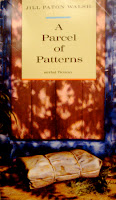
A Parcel of Patterns by Jill Paton Walsh is set in England in 1665. It tells the story of a small village called Eyam and its struggle with the Plague. The story is recounted through the eyes of Mall Percival, a young woman who lives in Eyam. The book is poignant in its description of Mall's reaction to the Plague as it isolates her village from the outside world, and especially as it isolates Mall from her love, who lives in another village. This book is sweet but sad, and is exceptionally well-written.


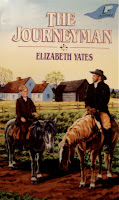
Set in New Hampshire in the 1800's, The Journeyman by Elizabeth Yates follows the life of Jared Austin from the time of his early apprenticeship to a traveling wall stenciler. As Jared is taught under the direction of expert stenciler Mr. Toppan, he embraces the life of a traveling artist, but hopes to one day return home to marry his sweetheart, Jennet. This book is very tender and uplifting.


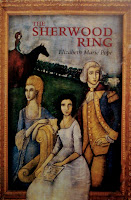
The Sherwood Ring by Elizabeth Marie Pope is one that I've read over and over again. Set in modern-day New England, it opens with orphaned teenager Peggy Grahame's journey to her uncle's antique house, which is to be her new home. Peggy has heard that the house is full of ghosts, a rumor which turns out to be true. However, these ghosts are merely her perfectly genial Revolutionary War-time ancestors, who are more than willing to recount lengthy - and humorous - stories from the 1700's. This book is written in a uniquely playful style, and is a lot of fun to read.